
Description
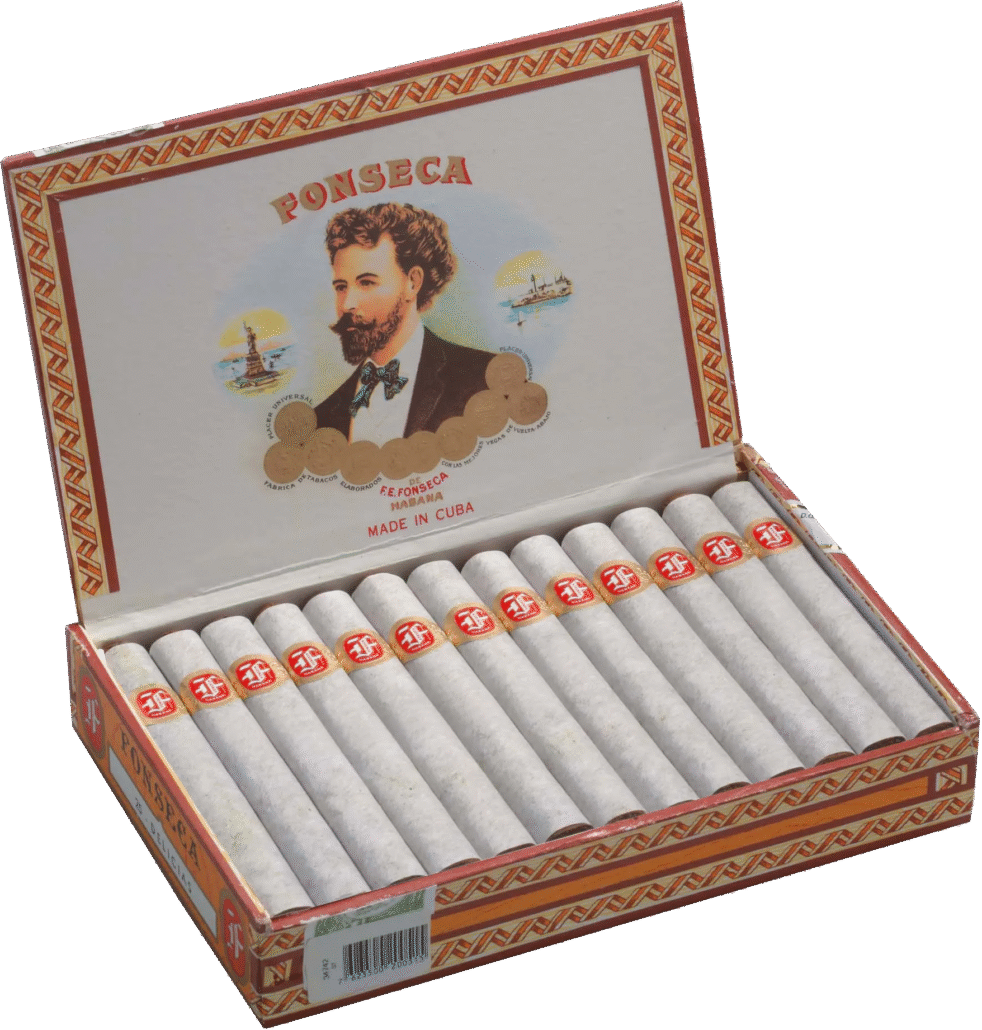
Don Francisco E. Fonseca, the creator of Fonseca cigars, was a man who cared deeply about appearance. Born on the island of Cuba, he established a Cuban cigar factory in his early twenties, as well as his own brand. Like many of his contemporaries, he chose his own name, proudly stamped on his creations. His adherence to the conventions of the time ended there.
Where other brands chose lithographic art with imaginative scenes – of Cuba, of the vegas where the tobacco was grown, or of great literary works (in the case of Romeo y Julieta the name was borrowed from there) – Don Fonseca chose his own portrait. He was a man who took pride in his appearance and placed great importance on tailoring and dress. The same applied to his cigars. Every single cigar that left the Fonseca factory was wrapped in fine silk paper, with the cigar band attached to the paper instead of directly to the cigar itself. This practice not only protected the wrapper leaf during transport, but also gave the product an extra touch of elegance and luxury in its presentation. The practice continues today.
This paper – a traditional Japanese product, handmade like the cigars it sometimes dresses, and able to cover the cigar without affecting the flavour in the way a cedar sleeve can – is not the only innovation credited to Don Francisco. He opened a “tasting room” in the factory so that valued customers could come and try several different blends before deciding on their favourite. This made it possible for Fonseca cigars to follow the example of Don Francisco’s highly regarded tailors and create bespoke cigars to order for special occasions, celebrations and banquets. In 1910 he began packing cigars in tin tubes, the forerunner of the aluminium tubos we have today and an important method for storing and protecting cigars smoked on the move. Though Don Francisco had a reputation for taking great care of his appearance, he was far from an empty-headed model.
Today all Fonseca cigars are hand-rolled, most with Tripa Larga (long filler) and one with Tripa Corta (short filler). All the tobacco used comes from the Vuelta Abajo region and is blended to a light strength. Although modern tastes often lean towards powerful cigars in large formats, Fonseca has shown remarkable staying power, with only 2 of the original 6 vitolas having been discontinued. The rest have been in almost continuous production since their launch.
Given the opportunity for elaborate presentations that Fonseca’s trademark silk paper provides, it is perhaps surprising that they have so rarely been chosen for special releases. No Limited Edition has come from this marca – somewhat less surprising, given the immense status of the few brands that have been allowed to participate – and only two Regional Editions. Having chosen Fonseca for their territorial exclusivity, France in 2011 and Benelux (Belgium, Luxembourg and the Netherlands) the year before are the only recipients of very small quantities of cigars rolled in a larger format than the brand usually produces.
The usual procedure for brands that produce very few Regular Production sticks is that they make up the bulk of one-off orders, but nothing about Fonseca has ever been entirely “ordinary”. Don Francisco Fonseca himself left Cuba for America at a time when most of his countrymen stayed to exploit the nation’s natural resources; he became a US citizen and resident of New York in 1903, ran a second factory in his new home city and periodically returned to Havana to oversee the original operation. He was a man of style and panache, and an entrepreneur with shrewdness, courage and a flair for innovation, and the brand that is his legacy cannot be expected to behave exactly like all the others. Part of the beauty and appeal of Fonseca cigars is their rarity; the same small production volume that creates this rarity also gives more time and opportunity to ensure higher quality. Fonseca is not the world’s biggest brand, but they are among the best – and deserve a place in every smoker’s collection.